A writer and a tropical muse. A funky Lubavitcher who enjoys watching the weather, hurricanes, listening to music while enjoying life with a sense of humor and trying to make sense of it all!
Monday, August 19, 2019
Monday Morning Look at the Tropics. Wrightsville Beach... 97L Moving Fast Away From the Coast... GOM Questions. New African Waves. Tropics Been Flat... Having Problems Getting Spin Going.
97L with diminishing chances of development.
But look how far North it is now.
Moving fast as systems do in that part of the ocean.
Models below.
Note models show it around for a while.
That's questionable we will see soon.
Model intensities all over the place.
Normally you throw out the high.
Then you throw out the low.
In this case there is little common ground.
It either survives or dies fast.
Being that I live in North Carolina.
And being that 97L was nearby.
I went to visit it a spell.
The beach was dark and gray.
Don't let the colors fool you.
It was hot as blazes.
Barely a breeze ....
...though there were waves.
And far off in the distance was 97L
Moving it's way North up along the NC coast.
People were out and about.
Lifeguards working hard.
Kids playing.
Adults enjoying the beauty of the beach.
You get a feel when you are there for things.
It's definitely there and definitely tropical.
But it definitely hasn't done anything yet.
The guys on the pier said Saturday was stormy.
There were puddles everywhere ... some localized flooding.
But mostly it was just a "hi there how ya doing" trip for 97L
Just moving along up the coast.
This is an image from last night.
Not much has changed.
RED is NO.
Green is GO.
Note every wave gets to the Caribbean...
...flares up briefly then falls apart.
A sliver of low shear in the Bahamas.
A sliver in the Atlantic...
Can't remember the last time I saw so many slivers.
Check out the loop.
Despite waves staying alive....
...they have no where to go once they hit the shear wall.
It's not a friendly ocean just yet.
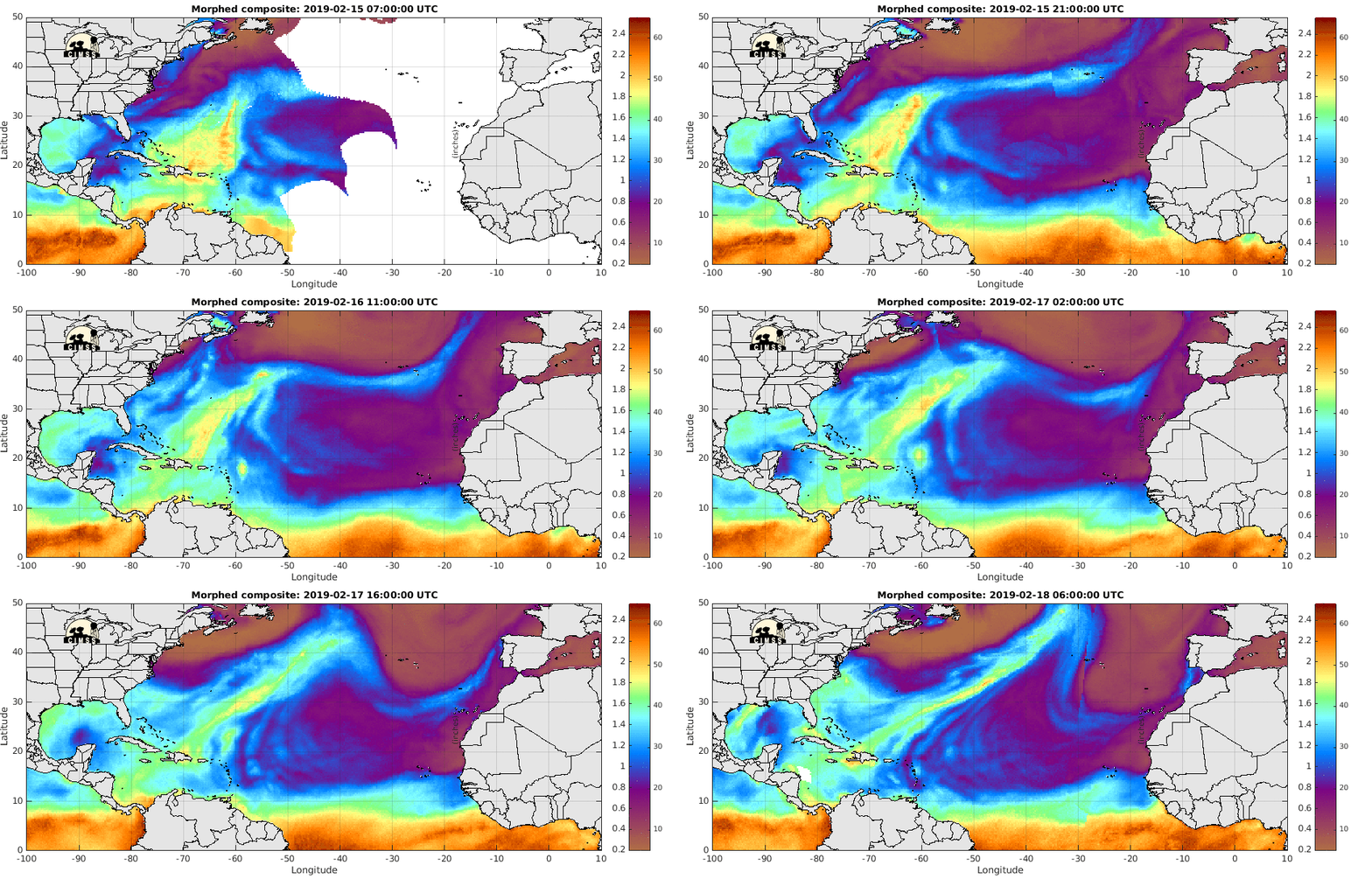
People love to talk on water temperature and SAL.
Shear is the real killer of any attempted development.
Updated Tropics Friday Evening.. 8 PM Yellow Circle Over Florida. Watching Models and Loops... Waves That are Silent Runners and Close In Areas for Possible Development.
Late breaking as expected NHC put up a yellow X over N FL
Putting this up fast before going off for the night.
I'm off for the Jewish Sabbath til tomorrow evening.
Have a blessed, beautiful weekend!
Official bottom line from the NHC.
Please keep reading as I wrote this earlier.
In anticipation of the 8PM update.
Note written earlier around 6 PM my thoughts...
NHC still has their nothing happening sign up.
Other signs point to possible development.
But as the song goes... time will tell.
Will the NHC respond soon with a small yellow circle?
Only the NHC knows..
(adding in here... yes they did...)
So I'm going to put this out here as sometimes things change rapidly close in, however nothing is expected to form or develop, it's a lot of moisture congregating around North Florida in the Gulf of Mexico. Some models play at concentrating the moisture into stronger areas of convection but they refrain from developing a named storm. Everyone is talking, complaining and bitching about the rain in parts of Florida and for good reason; it's been a whole lot of rain.
Most of social media has showed this one...
I feel their pain but it's no name rain for now.
Kind of looks like there's some spin.
Or it wants to spin.
But it's parked there.
Note there is another area off the Carolinas.
Down in the Caribbean there's more rain.
What's a bigger story than the rain?
The shear.....
If you thought SAL was bad....
...you haven't seen the shear maps.
Red means No.
Green means Go.
There's a sliver of where there isn't much shear.
And where there is less shear in the Atlantic....
...there's SAL.
Tho the set up with SAL may be slowly waning.
Things will be changing the next week or so a bit.
But unless something spins up fast close in...
...where there's warm water and green on the shear map.
It's rain.
Lots and lots of rain.
Mike has dubbed it a blob.
He's right on some levels.
The blob may shift around a bit.
But it's a blob of rain.
As for me I keep wondering if the NHC...
...is gonna put up a yellow circle over Arkansas.
Post traumatic Stress from the Yellow Circle over Tennessee
I guess ;)
Every day that blob forms...
...the new purple blob on Planet Earth.
Hang in there.... keep reading.
If models show some support.
The NHC could put up a yellow area.
But either way it's still rain.
Keep watching.
Trust me I will be.
Til we get something official from the NHC...
... just keep watching.
It's like when you used to wait for the phone to ring.
Remember that?
Some of you do...
...some don't.
Now days we get nervous when the phone rings.
Change is the one constant in our world.
If the phone doesn't ring it's me....
(keep reading if you didn't read Friday morning)
Some great links to loops you might want to save.
Or just save my blog ;)
I'd like to be out in the eye of the storm.
Bet some one here would like to be...
...in the eye of the storm.
Or at least at the beach in a storm.
Sweet Tropical Dreams
Can show it to you in Color too!
Not the strongest Atlantic waves today.
But they keep hanging in there...
...or trying to anyway.
Indian Ocean lit up.
But our wave train should depart the station soon.
Sometimes trains are late...
...if you use Amtrak you'll know what I mean.
So that's the wide view of the tropics above.
A wave that left Africa in the MDR.
MDR = Main Development Region for newbies.
Cluster of Convection in the NE GOM
Later with the heat of the day it will fire up more.
A weak Caribbean wave moving Westbound.
Why do we watch weak Caribbean waves you ask?
@DaDaBuh has a rule.
Okay he has LOTS of rules....
But he explains this well.
They move along like silent runners.
Barely there and then hit the 50 yard line.
Often waves can flare up in the Caribbean ....
...down near the Yucatan.
Sometimes the North end of a wave flares up....
...near PR and suddenly close to Florida.
Until the Atlantic Waves begin doing their thing.
We watch close in areas for development.
When the Atlantic Waves begin to kick in.
You'll know as everyone goes crazy.
Those dotted lines in the Atlantic....
...show the Saharan Dust.
There is a wave there way South of the SAL.
But the SAL sucks moisture out like a vacuum cleaner.
Kind of like this.
And everyone watching the tropics falls asleep.....
Not easy for people who wake up and check the NHC.
When things are slow in the tropics, as they usually are this time of year, it's good to read the NHC discussion on the Atlantic Basin. They have something to say about everything and often the amount of attention they give an area of the exact words they use show what they are watching for down the road development or by contrast areas they believe are shut down due to unfavorable conditions.
That's our area close in connected to constant convection and watching for any possibility of low pressure that could spin up. This front has become a semi permanent feature kicking up convection from the Carolinas to Florida and out into the Gulf of Mexico. The models have spit out small lows off the Carolinas and some believe models are indicating that low pressure could become an issue in the Central Gulf of Mexico. I'm a big believer if anything forms in the Gulf of Mexico that remains weak it will hook right to the NE or NNE with the flow. But eventually things can change so you can't judge next week by this week, but it's been a very persistent problem. And, until cooler air dives down and shoves these fronts out to sea each front replaces the previous front and where we had a large High Pressure System parked over the SE we now have a frontal boundary that doesn't want to leave. Often.... it's something big.... from up above or down below that kicks that pattern out. Could that kicker be a tropical storm or hurricane down the road? Probably faster than an Arctic front. Mother Nature generally finds a way to get it done.
Currently here's the picture.
Frontal Boundary.
Little orange dot is the current Caribbean Wave.
Moving along West bound.
Under a layer of shear that's there.
Will something develop?
Maybe.
But the location of it developing tells the story.
There is the chance it can develop near Louisiana..
(for example)
And crawl along the coastal boundary....
Visiting all the beach cities along the way.
Weak development means everyone gets weather.
Loops to watch and ponder on as we wait for the tropics to heat up and conditions to become favorable to where something could form close in or far away.
The wider view.
Big wave rolls off of Africa.
Goes poof in the water.
Does it flare up again?
That time of year that feels as if nothing will form ever.
And then it does.
Now look close in at Florida.
Always raining somewhere.
The sun goes up....
...the sun goes down.
August Climo.
Where do storms most likely form?
As for some Hurricane History?
1999 after a fast start was slow.
Then as usual it began to get busy.
Note how the switch was flipped.
A strong high and SAL owned the Atlantic.
And then it did not.
A look back at the beginning of Floyd.
I'll be back later this weekend...
...or if something pops up.
But for now...
Enjoy the summer.
What's left of the summer.
Go to the movies.
Go to the beach (but watch the weather)
Take the boat out if the weather is somewhere else.
Go shopping.
Lord knows there's a Mall somewhere that needs ya.
Caribbean Area 20% in 5 Day Say NHC. The Hype Begins. Models Give Us Clues. Convection is Strong. Shear Weakening. Spaghetti Models All Over It... I'm Making Spaghetti for Dinner. Is this Beryl? Stay Tuned.
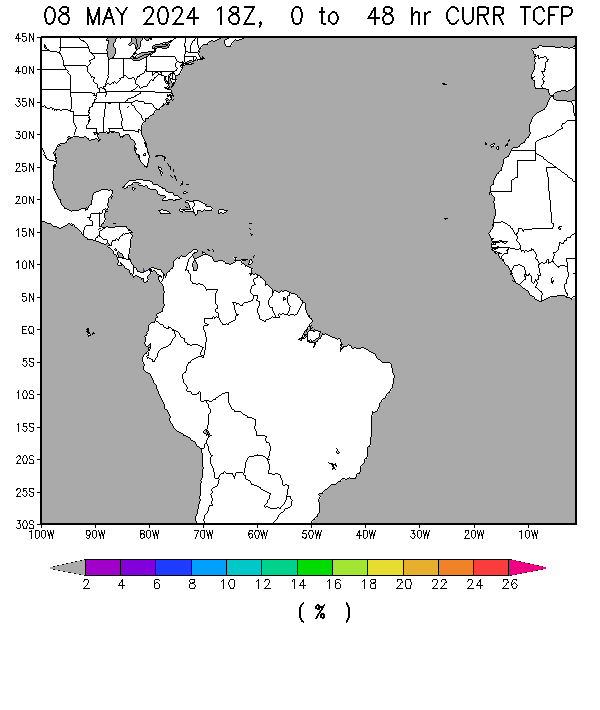
My bottom line on this is it's a watch and wait situation that can produce a number of different sort of systems each with their own possible problems. If it forms close to land, crosses the Yucatan or is inhibited by land for formation until after he moves off the Yucatan that would be a different system than one that forms slowly and slides through the Yucatan Channel. A poorly developed system scurrying up along the coast of Mexico and Texas produces one sort of storm. One that forms further to the East over water longer produces a different sort of storm. The water to the North of the Yucatan Channel is warmer than where this 20% area to watch is currently trying to maintain convection this afternoon. Note the tongue of warmer water stretching South towards our area that is up for consideration to be the next named system in the Atlantic.
Location of formation is everything.
Cranky made some salient comments in his blog that reads like the Great American Meteorological Novel making my blog seem more like Cliff Notes on the Great American Meteorological Novel. Cranky likes to give the impression he's "cranky" and well I do come across a bit perky or bubbly at times but in reality I'm pretty jaded. His concerns are well articulated and concurrent with my own reasoning with regard to this area of interesting convection. I really could care less this afternoon if the GFS or EURO weigh in differently in their next model run. The problem with models is that they show us many things and they can be translated and read differently and often something important is ignored as the person viewing the model is only looking for support of their own idea. When you begin a scientific experiment with a stubborn point of view you ignore the evidence that may be in front of you because it doesn't support your hypothesis. I'm not a model hugger but I do love to watch them curiously. "Through it all model interpretation is important" said Cranky and he is 100% accurate.
The 7 Day Loop that is visible on www.spaghettimodels.com as well as some other helpful long range graphics show that this system is already drawn onto the US maps as a closed Low making landfall in Texas. That may or may not happen but it's an early indication which way the wind is blowing and worth keeping in the back of your mind as you go about life today and tomorrow. In about 36 to 48 hours we should have a better idea of what is really going to happen. An image from that loop is shown below. http://www.wpc.ncep.noaa.gov/basicwx/day0-7loop.html
Lastly there's been much talk on SAL.
SAL is a feature that holds center stage in June and July.
Bursts of SAL are projected across the ocean.
SAL makes it to Key West, South Beach and beyond
Note it oozes into Texas and up to the Carolinas.
It hovers over South Florida often.
Asthmatics deal with it.
Photographers get tropical sunsets.
My son in Walnut Creek Florida took this picture.
Last night the sky suddenly turned hot pink.
That's because SAL is present.
Stay tuned.
I said to count 7 to 10 days after Aletta formed.
Add in Bud's presence so count a week from there.
Bud is moving rapidly towards Baja.
Shear is lessening in the Carib.
The MJO is moving into the Carib.
Climo adds a vote for development.
I'd say we could definitely get a TD at the least.
Location: Miami, Raleigh, Crown Heights, Florida, United States
Weather Historian. Studied meteorology and geography at FIU. Been quoted in Wall Street Journal, Washington Post & everywhere else... Lecturer, stormchaser, writer, dancer. If it's tropical it's topical ... covering the weather & musing on life. Follow me on Twitter @ https://twitter.com/#!/BobbiStorm