Hurricane Harbor

A writer and a tropical muse. A funky Lubavitcher who enjoys watching the weather, hurricanes, listening to music while enjoying life with a sense of humor and trying to make sense of it all!

Thursday, September 20, 2018

Tropics Today AND How Do We Repair the Saffir - Simpson Scale to Make It Convey Dangers of a Hurricane Better? It's Not All About WIND... People Die from INLAND FLOODING Not Just Storm Surge and Tornadoes In Bands... Even AFTER A Hurricane Is NO Longer MAJOR or "Just a Tropical Storm"


Note the tropics are not dead...
...because Florence is gone.
High chances for another high latitude system.
Subtropical or Tropical?
We've been here before.
Down in the Caribbean watching 97L
Been watching it for a while.


There is an area that could develop.
It has low chances.
It needs to be watched until it's dead, dead and deader.


There are silent runner waves ...
Getting past the SAL.
A ULL that could work it's way down to the surface.
Convection in the Caribbean.


I'll discuss that more tomorrow.
Today the big storm in the tropics is...
The discussion on the Saffir-Simpson Scale.
The way we define hurricanes.
Cat 1 vs Major Cat 4.

Everyone is talking.
Everyone has an opinion.


The debate goes on.
Will change happen?
Or do we wait for the next Cat 1 where 38 people die.
And the dollar amount can't even be put...
...onto the damage yet?


Some voices from people I respect very much.


Note also what Rob said.


This is true... we discussed this on Twitter.
He wanted people to keep their guard up.
He is a paid service...
... he is paid for what he does.
Tho he tweets information to all.

Did the NHC going by the basic scale?
Let the ball drop in ways in conveying the danger?
They work by rules. 
They are the Government not a Private service.
They have rules and ways of doing things.
They show a cone to show where the eye is moving.
That comes up short often with Tropical Storms...
..or Category 1 Hurricanes winding down in strength
Do we find a way to fix the Saffir-Simpson Scale?
Improve it or lose it?
Make a new scale?
There have always been wind speed scales.
But a hurricane is more than just "WIND"


An incredibly useful tool to tell you how strong the wind is blowing was devised in 1811 known as the Beaufort Wind Scale. Try it sometime in a summer storm or a tropical depression... on any very windy day you can really tell how strong the wind is blowing with this scale shown below.

https://en.wikipedia.org/wiki/Beaufort_scale


Mike has this graphic all the way at the bottom left.
Good to move around his page.
So much there.


Amazingly this scale really works.
Print it out.
You can keep it with you in case power goes out...
And you can really tell general wind speed by it.
It's a great rule of thumb.
Unless you live in some odd wind tunnel area.
Trust me this scale is as good as gold.
But hard to convey to the general public.


https://en.wikipedia.org/wiki/Saffir%E2%80%93Simpson_scale


In 1971 the Saffir - Simpson Scale was came along.
It is very easy to convey.
Breaks hurricanes into 5 categories.
Seems logical doesn't it?


From Google:


The truth is they both are good. The Saffir-Simpson Scale is a general way of judging a hurricane in a media based world where they want a headline and the NHC wants to convey the strength of a hurricane and though it isn't officially said ... the idea was to show how dangerous a hurricane is vs ordinary. Obviously no hurricane is ordinary and all have dangers but it's inherently understood a Major Hurricane (Category 3 to Category 5) is a deadly, dangerous hurricane.

I wrote extensively on my blog on my belief that we need to change the way we convey the dangers of hurricanes and the NHC needs to update it's cone to show dangerous weather not just the track of the "center" where the winds are highest in the eye. It gives a poor understanding to the public who figures the worst dangers must be in the "center" that the NHC is tracking and as areas not in the center (parts of NC that were FLOODED) they feel as the intensity of the winds go down their dangers also go down and therefore don't evacuate or drive back to Wilmington from the safety of Raleigh as I met a few people who were doing when she was downgraded to a Category 1 and the NHC put out charts and discussion saying if she made landfall at all she would bounce back or slide SE along the coast as far South possibly as Charleston. I know they were trying to warn people as far South as Savannah they could be in danger but they gave people in North Carolina inland that the DANGER was less ....almost as if a flag had been lowered down to "only a Category 1" and sliding SE along the coast away from North Carolina the danger was less now. Yes, obviously being slammed by a Cat 4 would have been worse, but the extreme danger of flooding, tornadoes and river flooding was there even with a weak Cat 1 and yes the "center" drifted S into South Carolina. The forecast verified, but the true dangers were lost in the shuffle in my opinion.


This graphic is the last one Wundergound posted.
When it was a Tropical Depression.
Dumping HUGE amounts of water on NC.
8.04 TRILLION GALLONS OF WATER FELL ON NC.
Where is that conveyed in warnings?
Where is that conveyed by the Saffir-Simpson scale?


Again many areas outside the "cone" for the "center"
Were swamped by flooding.


Currently there is a storm of controversy over the use of the Saffir-Simpson scale that is not new but often discussed over and over after hurricanes that suddenly drop down in intensity before landfall are suddenly underestimated by the general public as "not as dangerous." This did not begin with Florence as Hurricane Sandy, a once stronger hurricane, was downgraded just prior to landfall much as Florence was as it approached the Carolina coast. Earlier in Sandy's track people in Florida were terrified it would make landfall in Miami as a Major Hurricane and for some time it looked as if it would be stronger. But the NY area rarely gets hurricanes at all so the fears were real but with every drop in wind speed people let their guards down. Then it was downgraded just before landfall as it was falling apart as it climbed in latitude as hurricanes often do and then the damage began on a historic, major level as it flooded communities, swamped subways, leveled trees and became a disaster that some areas along the coast 6 years later are just moving past. Many whole blocks were leveled, torn down and new subdivisions had to be rebuilt. Would people have left the Breezy Point area that was leveled by flood water and a fire at the height of the storm for safety if the emphasis on the dangers of Sandy were based on flooding damage and storm surge and less on wind especially in that part of the world? Maybe.

http://articles.latimes.com/2013/oct/29/nation/la-na-breezy-point-20131030


Not Cat 1 damage.


Again Hurricane Matthew.
A monster Major Hurricane in the Caribbean.
Weakens as it climbs North.
But the damage was Major.


So what is the answer?

Is the problem the scale?
Is the problem the media?
Is the problem at the NHC?

Who and what is the real problem?
Ignorance or denial?

Every area has it's own unique concerns. In Miami, except at the coast where flooding is a problem from storm surge, wind is a huge concern if people do not board up their homes and coconuts or roof shingles go flying in the wind shattering windows not boarded up and once the wind gets into a house it does obscene things. Wind tunneling through skyscrapers does it seem huge damage even when people were told their windows were hurricane proof. While only a Category 2 Hurricane, after being downgraded from Category 5 in the Caribbean, Wilma wiped out the power grid in the Miami area, smashed windows said to be "hurricane proof" and walloped the general South Florida area badly for "only a Category 2 Hurricane" as people complained for weeks waiting for power to come back. Some areas had Category 1 winds yet the whole power grid went out with substation problems and poorly maintained lines prior to the hurricane.


What is the answer?
I don't know.
The Saffir - Simpson Scale is a good one.
The old Beaufort Wind Scale is great.
I think the cone sucks personally.
Sorry... but 38 people died.
The cone did not convey the real dangers.
Again the main page at the NHC...
..should be split with other graphics perhaps?
They are trying so hard to add warnings.
Storm surge was added after Sandy...
The earliest arrival of winds was added.
But the media just shows the cone.
The media just talks about wind speed.
Category 2... WOW ... MAJOR CANE CAT 3
Downgraded to a Cat 1.

What is the answer?
Hope we figure it out.
38 people died at the last count.
Many injured severely.
People homeless from floods.
As I said in my blog before...
The flooding in Mitch was not when she was a Cat 5!
Mitch stalled as a Tropical Storm and people died.
This happens all the time.
We need to get better at warning the public.
That starts at the NHC.
The MEDIA is a huge part of the problem.
And I mean mainstream media.
People like Mike on Facebook spoke on this.
I wrote on it.
The newspapers and TV media needs to change.
Just my thoughts.

Here are some thoughts from online .


Showing this one again on purpose.
I love Spectrum Weather.


Sorry but I don't feel that threat was conveyed well.
With the cone showed below.


We need to find the answer.
Because it will save lives.
Any lives saved are worth it.

Besos BobbiStorm
@bobbistorm on Twitter

Kinston is far inland.
Not sure if it was in the cone.
Doubt it was in the cone.
But the cone went S into South Carolina.
The flood waters inland rose....
Lumberton, Kinston so many communities.
Dillion, South Carolina.


If the audio doesn't work turn it to mute.
It's currently live.
Read the comments.


Not on the coast.
But it floods.
Far from where Florence turned S and went down to South Carolina.
Far from Wilmington NC where it made landfall.


Labels: , , , , , , , , , , ,

Sunday, July 01, 2018

Updated Monday AM July. SAL is in Charge of the East Atlantic. Waves Keep Rolling Off of Africa. Models Suggest Development Close In Along GOM of "Something" and Area E of FL Should be Watched. How Are You Beating the Heat? A Trip to Siler City in NC and a Look Back at 2012 A Year of Heat Waves, Derechos and Finally Hurricane Sandy.


Not there yet....
...still forecast to become a Hurricane.
NHC headline this morning.


Fabio is the only game in town today.
Why do we care?
Well if you have any surfer friends on the West Coast.
They care. Surf's up there!

Want to know what's going on in the weather?
Ask a surfer they always know.
It's wave season in the tropics.
Tropical Wave Season that is....


In the Atlantic Basin...


Lot's of areas to watch today.
The coast of the GOM is once again being watched.

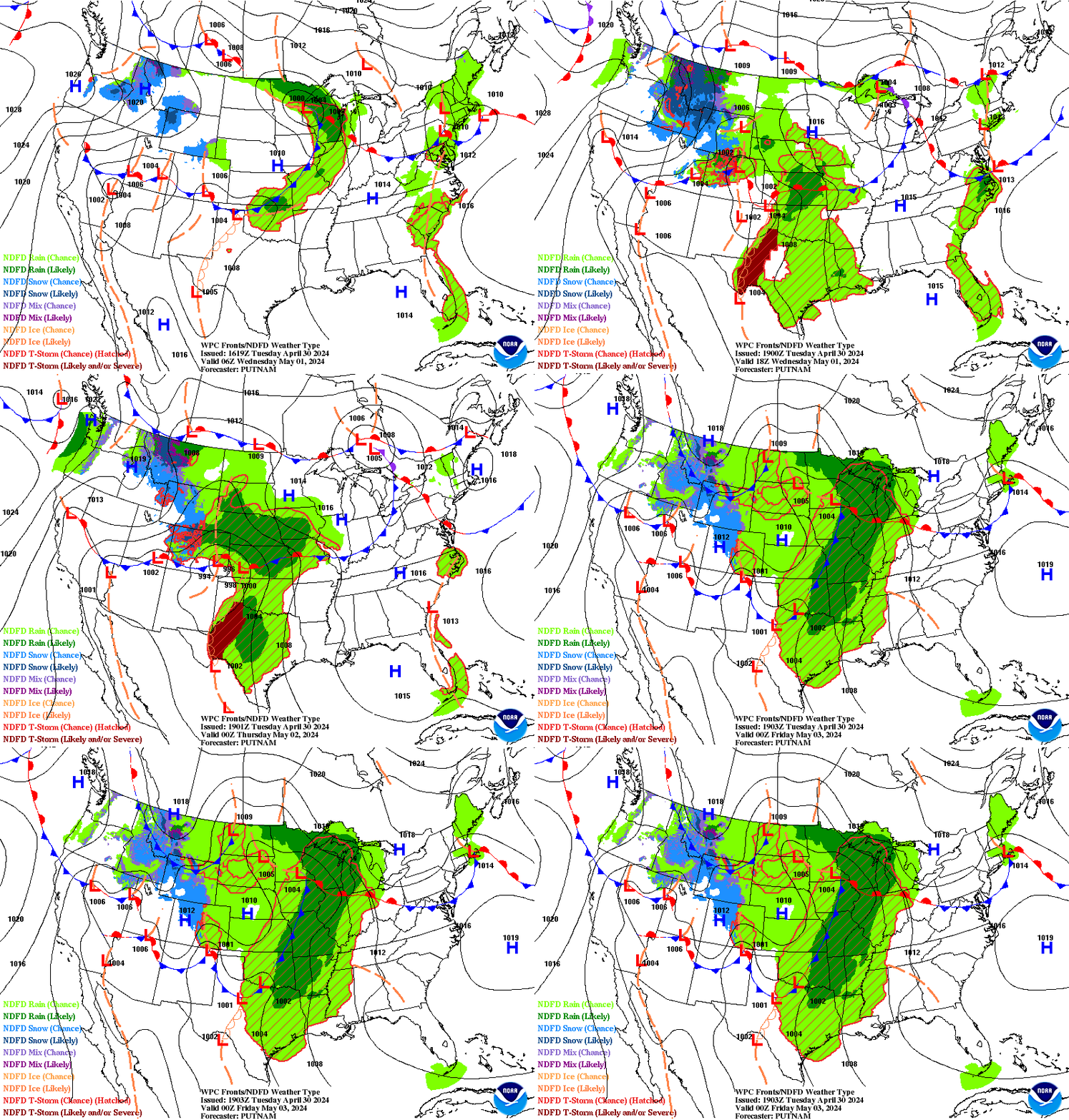
allfcsts_loop_ndfd.gif (799×559)

Yesterday Satellite view below


Today's satellite view below.


GOM bloby area flirting with the water. 
Convective swath in the Atlantic.
That's Westbound by the way.
Westbound across FL into the GOM.
Atlantic Tropical Wave still there...
...despite Saharan Dust to it's North.
July in the Tropics.
Many GOM storms started out E of Florida.
Katrina to name one.
Katrina a rare hurricane to mention.
Again they don't always form near Africa.
1935 another hurricane formed in the same spot.
Tropical systems can develop this way..
...from convection that moves Westbound.
So keep watching.
But enjoy a stellar July 4th Week!

latest72hrs.gif (947×405)

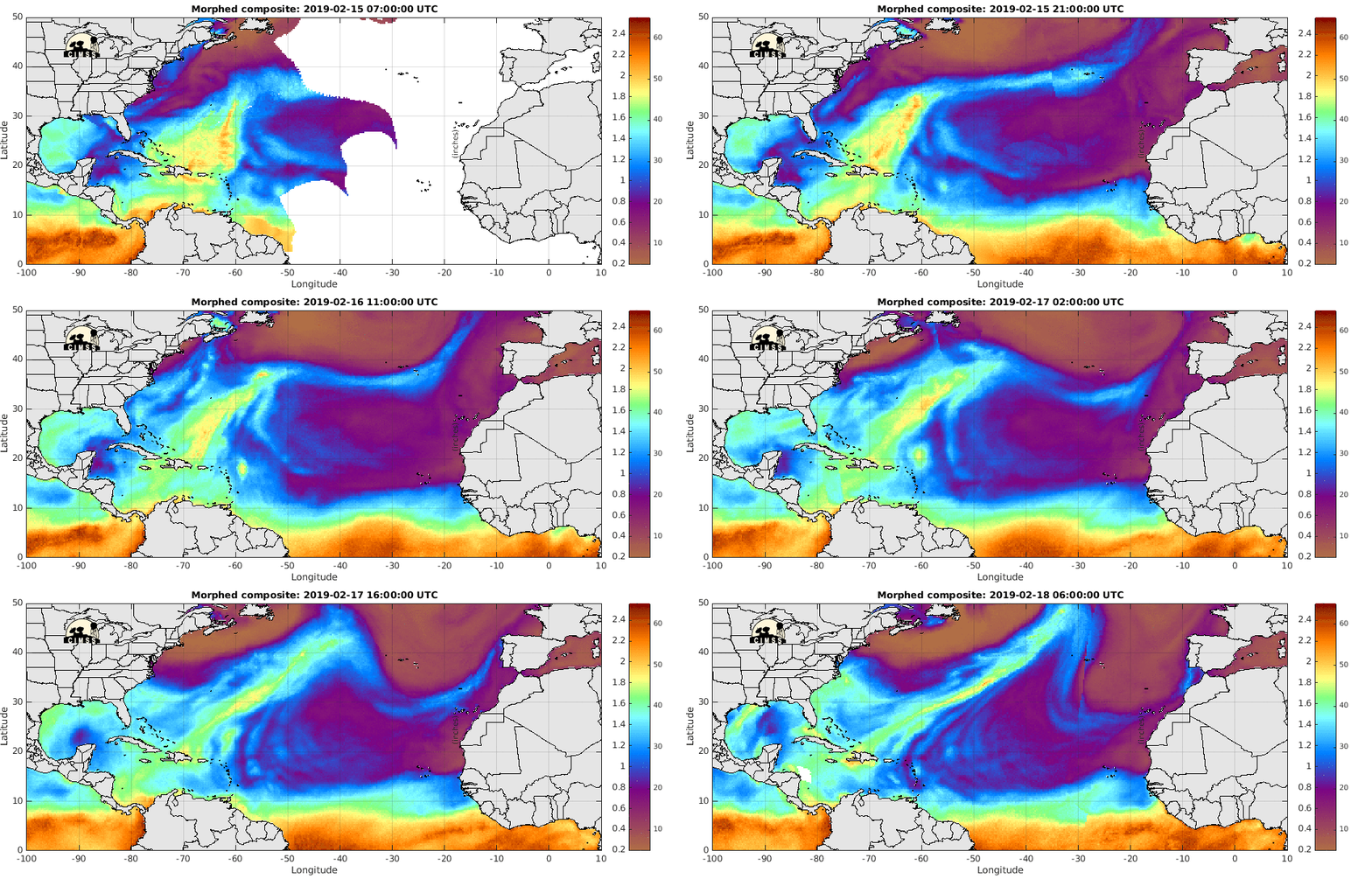
Note how the energy moves about.
Surges, oozes.
Very fluid.
Watery fireworks.
Moist, noticeable ITCZ
Surging slowly West.
Lifts over time.

So what do we think on today?

1. It's worth watching the area close in along the Gulf of Mexico for possible development down the road very close in. Models regularly develop something, but nothing tremendously strong. But even a slow moving wet mess can make misery for many as we learned a few weeks ago. Out in the Atlantic to the East of Florida is an area where pressures are lowering as pressures to the North of it are high and that usually allows pressures to drop to the South of said strong high pressure. Every day in every way there is more color in that area off of Florida and more moisture lingering over the warm waters of the Gulf of Mexico. Officially nothing is happening according to the NHC. 

2. It's also worth noting that even though the waves coming off of Africa are falling victim to the strong SAL now in control of the East Atlantic they are flaring up as they move into the Caribbean. This mornings discussion from the NHC spoke of a wave moving through the Islands kicking up some weather. Seems as strong as SAL is it's not totally killing the waves off as much as we would like.


3. I know it's hot. Everyone's talking about it. Maybe that's what adds to the hot air? Embrace the heat ;) Enjoy a cold drink or a dip in the pool or just stay home and keep taking cold showers. The struggle is real but there's always a way to enjoy the day. Often it involves Ice Cream ;)


I'm putting up some thoughts and links to actual research on topics we have seen tossed about as both click bait and headlines during these quiet days in the tropics. There is so much reposting of the same headlines regarding the possible arrivals of El Nino before Santa Claus is even done making your newest toy. There are headlines about cool water by Africa much cooler than last year and that would mean less hurricanes in total than last year. With or without cool water by Africa or a possibly developing El Nino the chance of having as powerfully, active a year as 2017 is slim to none for any number of reasons. In truth....there are so many factors that need to come together to have a busy hurricane season with storms strong enough to make it across the Atlantic Basin and make landfall along the Atlantic Coast. Often it's easier to hit the Caribbean Islands if Cape Verde storms are in play, but then again it's just as easy for them to become Fish storms swimming far away from even Bermuda. And, then you have to worry on hurricanes that form in the Caribbean and move North such as Hurricane Sandy, Hurricane Camille and Hurricane Katrina that formed just off of Florida and moved West into the Gulf of Mexico.

Let's look at the El Nino factor. Are we heading into an El Nino Year or is this a Neutral year? El Nino is called El Nino because we tend to expect him to show up the same way holiday decorations show up in November heading into the Christmas Season. It's not called Juno or Julio it's called El Nino for a reason. And, some years such as 1997 El Nino shows up whenever he wants to... wherever he wants to. But the 1997 El Nino was just as rare as the busy hurricane season of 1995 and the crazy intense hurricane season of 2017 when a hurricane couldn't form without ending up a Major Hurricane.

For the record 1997 was the Mother of El Ninos.
1995 was considered a weak El Nino year.
2017 was considered a weak La Nina year.
The jury is still out on 2018.

You can look through the lists below and read up on El Nino and La Nina and the various Neutral years.

https://www.weather.gov/tbw/tampabayelninopage

Where are we currently? We are waiting to see what actually happens. But, despite what is happening people keep reposting, rewriting the same articles that were passed around last week and the week before that. Currently we are not there yet...

No real stand out orange red pool of water.
Some warm color off of Peru.
A bit of cold blue water by Chile.
A warm pool of water East of Spain.
Cool blue waters around 15 N.
Yellow warmer water around 5N
Hey warm water off the E coast of Brazil..


Let's compare this to other years.


Whoah! 
You can see how different this year is from those above.
Neither here nor there yet.

As for 1995.... 
Chicago had a Heat Wave from Hell that summer.


Will our hurricane season heat up in the same way or does that not factor into analog discussion? There are so many ways to slice and dice historical weather. Let's look at 2012 another year with a historical Heat Wave along the Mid Atlantic. Actually a derecho hit the same area and it looked like the end of the world. Links below show that info. 


Interesting though...
... 2012 got way worse.


Is there a correlation?
Was it a coincidence?
2012 was a moderate La Nina.
Not such a moderate hurricane season though..


Time will tell but the real story will be told in August when historically the East Atlantic Warms up and SAL wanes enough after wave after wave moistens up the atmosphere trying to make a moist, warm atmosphere for August and September tropical waves coming off of Africa. SAL is making big headlines. What the articles don't tell you is June and July are to SAL what September is to the Hurricane Season; this is SAL's time of year. SAL is extremely strong this year. Oddly waves coming off of Africa are just as stubbornly strong for June and early July. Again time will tell. We are not there yet.

2012 below.


Look closer.
Looks familiar doesn't it?


Let's look at this year currently.


Basically pretty normal.
Stronger than average.
Exact time of year we deal with SAL.
Heat Alerts a bit early.


So let's look back at 2012 as a year with a similar early, strong heat wave in late June and July. It turns out we were dealing with strong Saharan Dust outbreaks that year and there were studies done then that are worth reading up on if you have the time and would like to sit a spell in the AC while drinking Iced Tea (Sweet of course) and maybe use a good meteorological dictionary. It's not that hard a report to understand. Good work.


Note it says that when SAL is strong it inhibits sunlight and the water off of Africa is noticeably cooler. Makes sense. Note that despite the strong SAL and the various other aspects that affect Hurricane Season 2012 turned out to be a dangerous year for a good part of the Atlantic Basin especially with regard to the Mid Atlantic Coast that was besieged by numerous heat alerts and derechos as well as Saharan Dust making beautiful tropical colored sunsets in South Florida and beyond.

Looking back at my own blog you'll see I was concerned about the weather events in the Mid Atlantic and reminding readers that the 1954 Hurricane Season showed the Mid Atlantic being besieged by Hurricanes. We had strong weather in Iowa (flooding, storms), waves coming off Africa early succumbing to SAL and what apparently was record heat in Raleigh matching patterns for 1954 the same time of year as last week's "epic" heat wave in Raleigh. Nothing new under the sun really. But patterns do exist and need to be watched carefully to see if they repeat but with their own unique spin on a remake of other infamous hurricane seasons.


Above was 2012 in late June.
Sounds familiar doesn't it.
Looks a bit familiar.

hiatlsat_None_anim.gif (768×496)


Later in the 2012 things changed.
As they so often do.

You can watch yourself.
Note it took a while to get going.
GOM fluff and stuff.
Outbreaks of SAL visible.


Then it gets busy.

Here's a video with time stamps.


2012 had a virtual tropical buffet of all you can eat storms both weak and strong storms, Fish Storms that developed when the SAL waned and zoomed up harmlessly into the East Atlantic and then when the EPAC season waned Hurricane Sandy formed in the Caribbean, trashed Cuba, threatened Florida and took aim on the Mid Atlantic States making historic impacts on the beaches of New Jersey and New York.  A hurricane to remember. But earlier in the summer we were worried on historic heat and derechos and making jokes about SAL and how beautiful the sunsets were in June and July. Then things changed. 

As always time will tell.


1994 and 1995
Note commonality.
East Atlantic storms form later in the season.
Almost always.
Even weak systems can cause misery.

An excellent compare and contrast hurricane research study is posted below as relates to the image above from said report. The report compares the 1994 hurricane season to the busier 1995 hurricane season. This is what we do basically we study and research and try to figure out how to better warn people when a hurricane is actually on the map and tracking towards a possible landfall. This year may be a way quieter year with less ACE as it's doubtful we will have as many hurricanes let alone as many major hurricanes as 2017 produced. However as always time will tell and we won't know until the year is over. And, then .... we will study the 2018 Atlantic Hurricane Season for clues to better warn people in 2019; maybe finally figuring out the holy grail of better being able to predict rapid intensification. This is what meteorologists do... they study, they research, they compare notes, collaborate and re-evaluate what we knew in the past with what we know now. 


We compare, we contrast, we complain it's slow then we complain we can't keep up because it's so busy. Nothing new under the sun. We wait for summer to begin, then we count down the days until cooler weather in the Fall. Are we ever really happy? Sometimes I wonder...


Today was a beautiful, extremely hot day in Raleigh. It was record breaking hot in many places especially along the East Coast. The press getting a vacation from ongoing polarizing news stories from the left to the right camps is suddenly talking about weather. Really, I'd rather talk weather than politics any day.

I went for a ride with my husband out towards Pittsboro where I got some awesome books at one of the best used book stores around. We then drove out to Siler City as I've always wondered what was such a big deal about Siler City as Andy Griffith was always going there on the Andy Griffith Show. It was a nice drive, rolling hills, forested areas, farms and apparently the actress who played Aunt Bee is buried there. Now I know the rest of the story. Cross that one off my Bucket List. It's changed a lot since Aunt Bee died as the Walmart moved in and it's the busiest part of town... the bank was busy, the Subway was busy and well things change but things don't change all that much. 


(She was in the Day the Earth Stood Still??? Wow!!)


Nice day......... 
This is July 4th Week... some people took off this weekend, some took off next weekend and some if they can are just taking off the whole week! Jordan Lake on the way back was busy with boaters, hawks and eagles circling in the sky while I watched the clouds fly by. North Carolina is as beautiful and real as Aunt Bee said it was ... and even if it was 94 degres with a heat index of 105 the AC was cool, the view was beautiful and listen it's summer. This is what happens in the summer. It gets hot. And, then it gets not so hot. Then cold fronts try to move again just as tropical waves really begin to find their groove and suddenly no one is talking about Cousin SAL anymore. The El Nino discussion will continue until he either arrives on time, early or not really at all. 

Besos BobbiStorm
@bobbistorm on Twitter

Ps..........  Keep watching the Gulf of Mexico very close in and the area off the East Coast that shows promise for some development. Enjoy those colorful sunsets, they don't last forever; the same way the fireflies of June disappear in July stronger waves begin to be contenders as we move towards August. Have a wonderful July! I'm making a late night dinner of BBQ Chicken, fresh corn from the Piggly Wiggly in Pittsboro and a beautiful sald. Oh... Sweet Potatoes also! Y'all come back now real soon. Perhaps we will eventually have something to talk about; even an Invest or a weak kneed tropical storm. 


Labels: , , , , , , , , , , , ,